MOQ Meaning and MOQ Calculator
What a minimum order quantity means, and what it does to your order: type the supplier's MOQ and your plan to see the cost, the extra stock and a price to negotiate with.
MOQ meaning in sourcing: MOQ stands for minimum order quantity, the smallest amount a supplier will accept in a single order. The MOQ calculator on this page works out what that minimum costs you, how many extra units you would pay for, and whether the order fits your budget. It is free to use, and it shows the smallest order, your order after rounding, the cost per unit you actually need, and a price to ask for a smaller order.
Use it when a supplier quotes a MOQ and you need to know whether you can afford it, or whether you will end up with more stock than you planned.
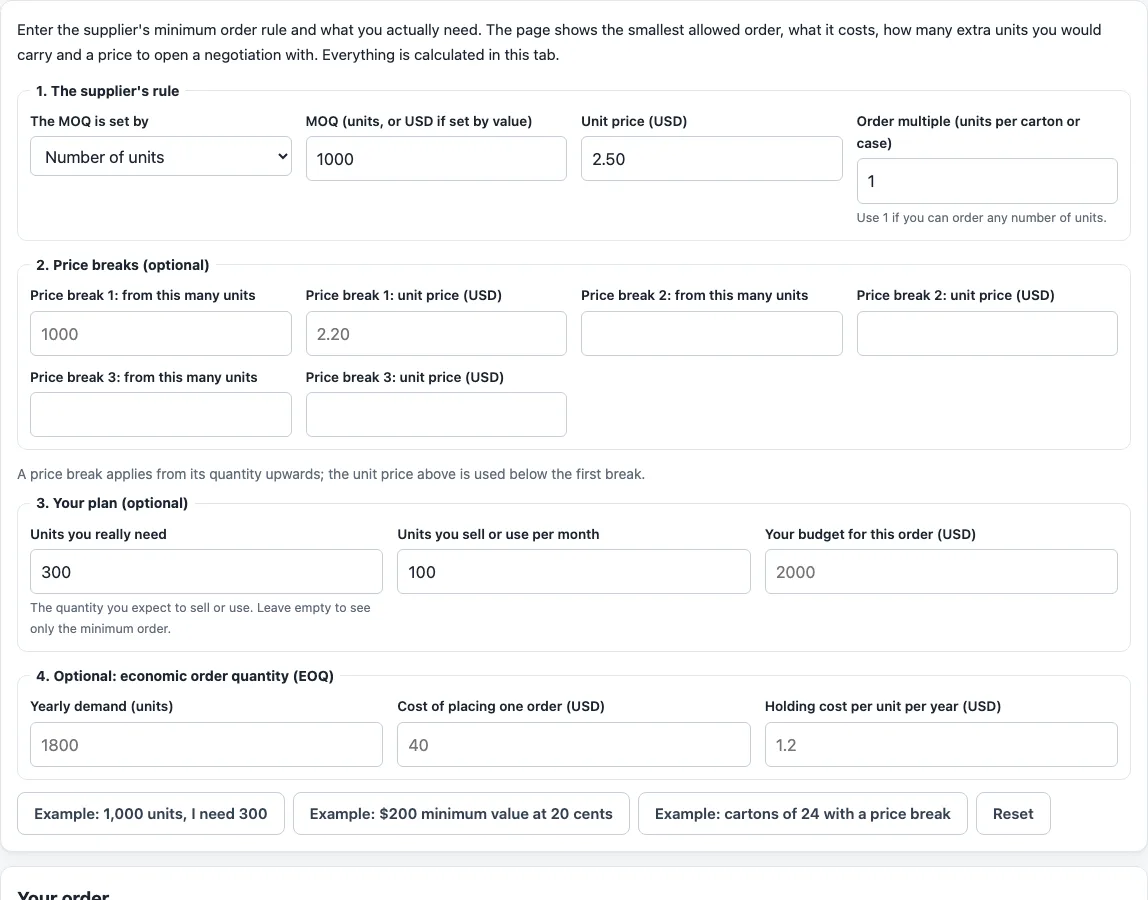
How to use the MOQ calculator
- Pick how the MOQ is set: Number of units or Order value in USD.
- Type the MOQ in that unit.
- Enter the Unit price (USD).
- Enter the Order multiple, the units per carton or case. Use 1 if any number of units is allowed. If the MOQ is set by value, the calculator finds the smallest number of units, rounded up to the multiple, whose value reaches it.
- Optional: add up to three price breaks. For each one, enter the quantity it starts from and the unit price at that quantity; a break applies from that quantity upward.
- Enter Units you really need.
- Enter Units you sell or use per month.
- Enter Your budget for this order (USD).
- Optional: fill in yearly demand, the cost of placing one order and the holding cost per unit per year to compare the MOQ with EOQ.
- Read the results: the smallest order, your order, the extra units and their cost, the cost per unit you need, the price to ask for, months of stock, and the budget check.
The three example buttons fill the form with sample numbers so you can see how a result is built. Reset clears the form. Copy summary copies the results so you can paste them somewhere else.
What is MOQ?
MOQ, or minimum order quantity, is the smallest order a supplier will accept in one go. It can be set as a number of units, such as 300 units, or as a total order value, such as $2,000. A MOQ can also come with rules, such as buying in multiples like boxes of 12 or full pallets, or a minimum for each color and size.
For example, if pens sell at 20 cents each and the MOQ is 1,000 units, you must spend at least $200 (20 cents x 1,000). Suppliers may also set a higher first-order MOQ for a new buyer, and a lower one for repeat buyers who pay on time. The higher first-order figure covers the cost of opening an account, checking credit and adjusting a production line.
Why do suppliers set a minimum order quantity?
Suppliers set a minimum so that each order covers their costs and leaves a profit. Making a product run has fixed costs that do not shrink for a small order, such as tooling, machine setup, changeovers and labor for each run. A minimum also keeps production volume consistent.
A minimum helps with packing and shipping too, because products are packed in case-pack quantities, pallet layers and full containers. Finally, the supplier’s own vendors often have minimums for fabric, ingredients, components or packaging, and those minimums can flow through to you.
What is the difference between MOQ and EOQ?
MOQ is the smallest order a supplier allows, and it is set from their costs. EOQ, or economic order quantity, is the order size that keeps your own total inventory costs as low as possible, and it is set from your costs.
The formula is EOQ = square root of (2 x D x S / H), where D is yearly demand in units, S is the cost of placing one order, and H is the holding cost per unit per year. For example, with yearly demand of 1,800 units, an order cost of $40 and a holding cost of $1.20 per unit per year, the EOQ is about 346 units. If the MOQ is 504 or 1,000 units, it sits above that cost-minimising order, so you would buy more than your own cost model suggests.
How do I negotiate a lower MOQ?
Start by asking the supplier directly, and know in advance what you can accept. Common approaches:
- Offer a higher price per unit for a smaller order.
- Ask about alternative materials or components, because a high MOQ often comes from a part the supplier must buy in bulk.
- Agree to buy the full MOQ but take delivery in batches.
- Propose a long-term contract.
Small buyers can also pool orders in a purchasing group, or look for suppliers that specialise in small batches.
Use the calculator’s price to ask as a starting point. It is the highest unit price for only your quantity that costs no more than buying the full MOQ. In example 1, with a MOQ of 1,000 units at $2.50 and a need of 300 units, that price is $8.33 per unit, which is 233.3% above $2.50. The price does not promise that a supplier will agree.
Can I order less than the MOQ?
Usually not from that supplier in a single order, because the MOQ is the smallest order they will accept. You have three realistic routes: pay for the extra units, ask for a smaller order at a higher unit price, or look for a supplier with a lower minimum.
The calculator shows the cost of the first route. In example 1, you need 300 units but the MOQ is 1,000, so you would buy 700 extra units worth $1,750. At 100 units a month, 1,000 units last about 10 months.
Is anything uploaded when I use the calculator?
No. The calculator runs entirely in your browser, and nothing you type is uploaded. Your numbers stay on your device while you work with them.
Sources read for this page
Opened on the dates shown; notes say where we used a substitute.
- Shopify blog (Chris Pitocco, 2026-05-27): MOQ: Definition and Negotiation Tactics (read 2026-10-18). A retail-software company's guide: used for the definition (smallest quantity a supplier will accept in one order), unit-based and value-based MOQs, multiples, why suppliers set MOQs, the EOQ formula and the negotiation ideas (higher unit price, alternative materials, staggered delivery, long-term contract).
Frequently asked questions
How do I turn a dollar minimum into a unit count?
Divide the minimum value by the unit price, then round up to a whole unit. A $1,000 minimum at $3.30 a unit is 304 units (303.03 rounded up). If the supplier sells in cartons of 12, the order rounds up again to 312 units.
What happens when the MOQ has to be a multiple?
Your order rounds up to the next multiple. A MOQ of 500 units sold in cartons of 24 rounds up to 504 units. If you need 900 units, the order becomes 912 units (38 cartons), which costs $3,648 at $4 a unit.
How do price breaks change the order size?
A price break applies from its quantity upward, so the lower unit price starts once you reach that quantity. For example, at $4 a unit with a break of $3.50 from 1,000 units, a value MOQ of $4,100 needs 1,172 units, because 4,100 / 3.50 = 1,171.4, rounded up.
What does the budget check tell me?
It compares the total cost of your order with the budget you entered. If the order is over budget, the result also shows how many units the budget buys at those prices. For example, a $3,648 order is $648 over a $3,000 budget, and the budget buys 744 units (31 whole cartons of 24) at $4 each.
Does the calculator confirm that a supplier will accept a lower MOQ?
No. The calculator works only from the numbers you type. It does not know any supplier, cannot tell whether a supplier will lower a MOQ, and does not cover quality, lead time, shipping or duties. For those costs, use the landed cost calculator on the how to import from China page.
Do I need to enter amounts in US dollars?
Yes. The unit price, order value and budget fields are labelled in USD, so convert your supplier’s quote to US dollars before you enter it.
Related tools
- How to Import From China: Steps, Duties and a Landed Cost Tool: use it for the full import process and the landed cost calculator for shipping and duties.
- China Factory: How to Find a Manufacturer, Free RFQ Builder: use it when you are still looking for a factory to ask about MOQs.
- China Wholesale: How Buying in Bulk Works, With a Cost Calculator: use it to learn how wholesale ordering works before you compare minimums.
- China Wholesale Suppliers: How to Find and Contact Them: use it when you want a list of suppliers to compare MOQs across.
- Alibaba Trading Company vs Factory: How to Tell a Supplier Apart: check whether a supplier is a factory or a trading company before you negotiate.
- Sourcing Agent China: What Agents Do and How to Check One: what a sourcing agent does, and what to ask one before you hire.