How to Import From China to the USA
The steps in order, what to look up officially, and a calculator that adds up the landed cost per unit.
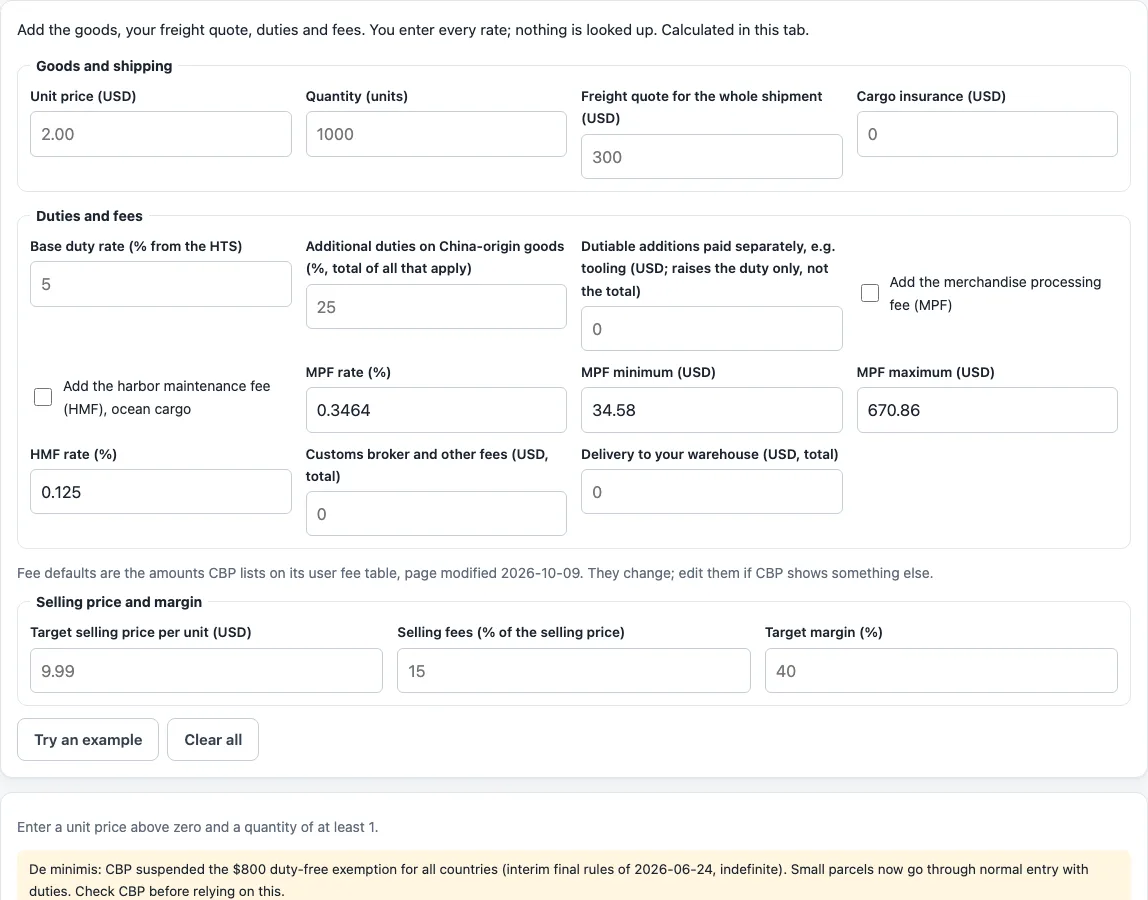
How to use the Landed cost calculator
Have your supplier quote and your product’s HTS code ready before you start.
- Enter the unit price in USD.
- Enter the quantity.
- Enter the freight quote for the whole shipment. The calculator does not estimate freight, so use a real quote.
- Enter insurance, if you buy it (optional).
- Type the base duty rate in percent, taken from the HTS code.
- Enter each additional duty on China-origin goods in percent. Add every one that applies to your product.
- Enter other dutiable additions, such as tooling.
- If they apply, tick the boxes to add the merchandise processing fee (MPF) and harbor maintenance fee (HMF). Their rates are filled in from CBP’s fee table and you can edit them.
- Enter broker and other fees, and the cost of delivery to your warehouse.
- Optionally, enter a target selling price, selling fees in percent and a target margin.
- Read the results: total landed cost, landed cost per unit, the table showing each cost and its share, and, if you entered a selling price, the profit per unit, margin, break-even price and the price needed for your target margin.
The calculator contains no tariff rates. Look up the base rate yourself in the USITC Harmonized Tariff Schedule search at hts.usitc.gov, and check the current MPF and HMF rates with CBP, since both change over time.
How do I import from China to the USA step by step?
Importing from China to the USA means buying the product, clearing US customs and taking delivery. Settle price and delivery terms before anything ships.
- Decide the product and find its HTS code.
- Find a supplier and verify it.
- Send a request for quotation (RFQ) and order a sample.
- Agree on price, Incoterm and payment terms in writing.
- Arrange inspection before shipping.
- Ship the goods.
- The importer of record files the customs entry. Many importers use a licensed customs broker for this.
- Pay the duty and fees, then take delivery.
This guide covers US imports only.
How much duty will I pay on goods from China?
Duty is the base rate from the HTS code plus any additional duties that apply to the goods. Goods made in China can carry extra duties, most notably Section 301 duties, which apply to products of the People’s Republic of China based on country of origin, not the country they were shipped from. Goods from Hong Kong and Macau are excluded from these duties.
USTR’s Section 301 page lists the actions (List 1 to List 4) and exclusion processes. Rates and exclusions change, so look up the current ones before you calculate.
Duty is charged on the value of the goods plus any dutiable additions such as tooling; documented international freight and insurance are normally left out. Customs user fees are added on top. The MPF for formal entries is 0.3464 percent, with a minimum of $34.58 and a maximum of $670.86, plus a $4.15 manual surcharge. The HMF is 0.125 percent of the value of the merchandise.
Add the base duty, extra duties, fees, freight and other costs to the goods value, then divide by the quantity: that is the landed cost per unit.
What is an Incoterm and which should I use?
An Incoterm is a standard trade term, published by the International Chamber of Commerce (ICC), that sets out which party pays for each part of the journey and when the risk of loss moves to the buyer. Incoterms 2020 has eleven rules. Seven can be used with any mode of transport: EXW, FCA, CPT, CIP, DAP, DPU and DDP. Four are only for sea and inland waterway transport: FAS, FOB, CFR and CIF.
There is no single best term. EXW leaves the most work and cost to you, while DDP leaves the most to the seller. Whichever term you pick, put it in the contract with the price: it decides which costs you add in the calculator, so the freight quote and fees should match it.
What is the de minimis rule now?
De minimis is a threshold below which shipments of low value can enter the United States duty-free. That exemption is no longer a safe assumption. According to a June 2026 summary from the law firm Thompson Hine, two CBP interim final rules published on 24 June 2026 indefinitely suspend the $800 de minimis duty-free exemption for all modes of transport. The same summary says the One Big Beautiful Bill Act removes the statutory exemption from 1 July 2027.
So small China-origin parcels are not duty-free by default. CBP’s e-commerce page also says the compliance date for the new informal entry procedures for international mail moved to 20 January 2027. Check CBP before you plan a small shipment.
Sources read for this page
Opened on the dates shown; notes say where we used a substitute.
- USITC: Harmonized Tariff Schedule search (read page opened; it is a script-driven search tool)
- CBP: Section 301 trade remedies, FAQ (last updated 2025-04-14) (read 2026-10-17)
- USTR: China Section 301 tariff actions and exclusion process (read 2026-10-17)
- CBP: E-commerce (de minimis status, page last modified 2026-10-15) (read 2026-10-17)
- Thompson Hine, June 2026: CBP interim final rules indefinitely suspending de minimis (read 2026-10-17). Law-firm summary of the Federal Register rules 2026-12670 and 2026-12669 (both 2026-06-24).
- CBP: User fee table (page last modified 2026-10-09) (read 2026-10-17)
- CBP: What every member of the trade community should know about customs value (read 2026-10-17). Read through a search summary of CBP guidance and rulings (international freight and insurance are excluded from transaction value when documented); the guide is from 2006.
- ICC: Incoterms 2020 rules (read 2026-10-17)
- ICC Digital Library: the rules for any mode or modes of transport (read 2026-10-17). Group headings read through a search snippet.
Frequently asked questions
Do I need a customs broker?
The importer of record is responsible for filing the customs entry, and many importers hire a licensed customs broker to do it. If you use one, ask for a written quote and enter it under broker and other fees in the calculator.
Does the calculator estimate shipping costs?
No. You enter the freight quote for the whole shipment yourself. The calculator does not estimate freight.
Where do I find the duty rate for my product?
Search the HTS code for your product in the USITC Harmonized Tariff Schedule search at hts.usitc.gov. The calculator does not contain any tariff rates, so type the base rate in yourself.
Do Section 301 duties apply to goods made in Hong Kong or Macau?
No. CBP’s Section 301 FAQ says the additional duties apply to products of the People’s Republic of China and do not apply to goods from Hong Kong or Macau.
Are the MPF and HMF rates fixed?
No. The defaults in the calculator come from CBP’s user fee table. Because CBP adjusts them over time, check the current figures and edit the fields if needed.
Is the calculator free to use?
Yes. It runs in your browser and is free. It uploads nothing and looks nothing up.
Does the calculator use my data?
Nothing is uploaded. You type every number, and the calculation runs in your browser.
Can I work out the price I need to sell at?
Yes, if you enter a target selling price, selling fees in percent and a target margin. The results then show the profit per unit, margin, break-even price and the price needed to reach your target margin.
Related tools
- China wholesale: Use it when you are looking for wholesale suppliers in China.
- Buy from China safely: Use it to check a supplier before you pay.
- RFQ builder in the manufacturer guide: Use it to put together a request for quotation to send to suppliers.
- Is Alibaba legit?: Read this to see what is known about the platform and its suppliers.