China Factory: How to Find a Manufacturer
Write the request once, send it to several factories and compare. The builder produces an English message and a Chinese version.
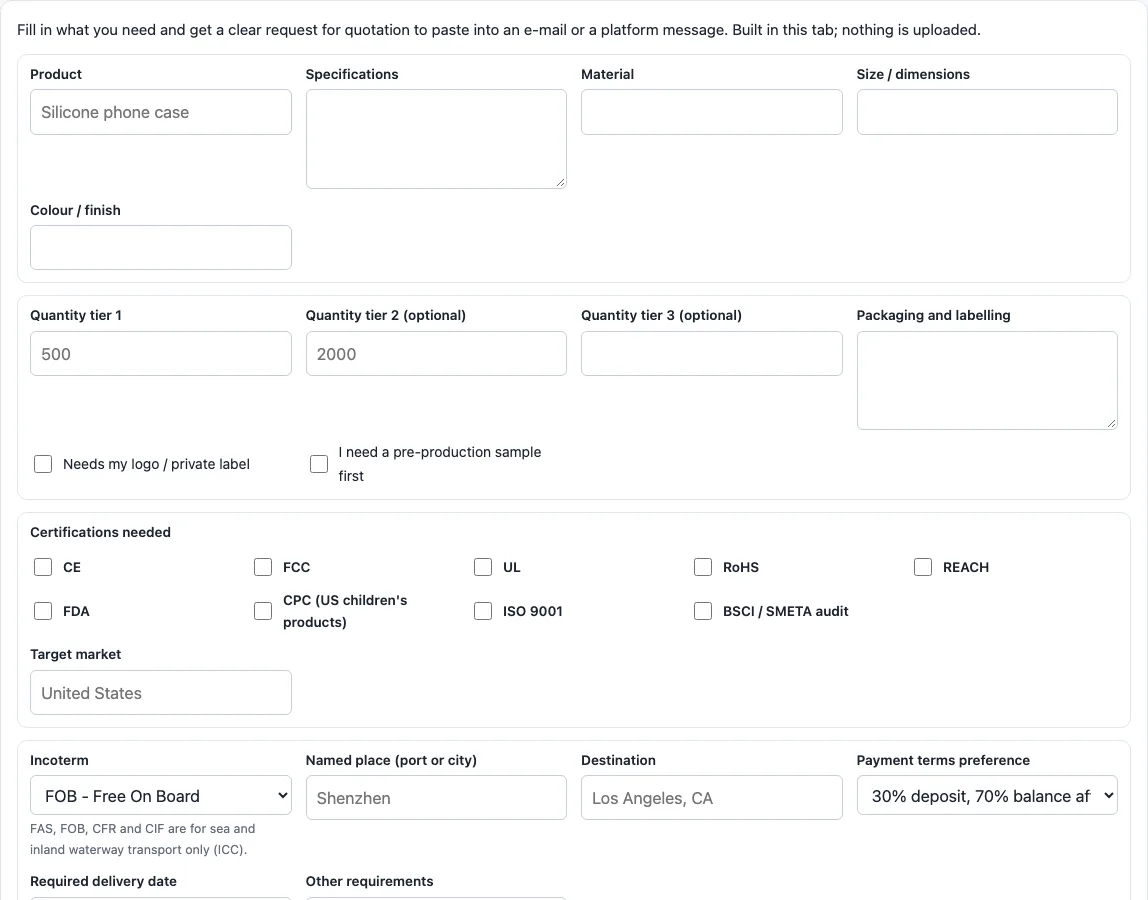
How to use the RFQ builder
- Enter the product name and its specifications, material, size, and colour or finish.
- Add up to three quantity tiers so you can compare unit prices at different volumes.
- Describe packaging and labelling, and say whether you need your logo or a private label.
- Select any certifications the product needs from the list: CE, FCC, UL, RoHS, REACH, FDA, CPC, ISO 9001, or BSCI / SMETA.
- Enter your target market and destination, and say whether a pre-production sample is needed.
- Choose an Incoterm and named place, then add your payment terms preference and required delivery date.
- Add any other requirements, then enter your buyer company and name.
- Read the English e-mail subject and body, then open the second tab to see the Simplified Chinese version.
Use the Copy button to paste the text into your e-mail, or choose Download .txt to save a copy. The Chinese tab translates only the fixed wording. What you typed stays in your own language, so check your entries before you send.
Use Try an example to see a filled-in RFQ, and Clear all to start another product. Send the same text to each factory, so the replies can be compared line by line.
How do I find a manufacturer for my product?
Start by writing down what you want made, in enough detail that a factory can quote it. A manufacturer is the company that makes the goods, while a trader buys them from others and resells them, so your search should look for makers.
Write a specification with drawings, materials, tolerances and required certifications. Decide your quantity tiers. Then build a candidate list from B2B platforms, trade fairs and referrals. On Alibaba.com you can search by keyword or send a Request for Quotation so sellers bid, and you can filter for Trade Assurance suppliers, whose funds are held in escrow when you pay on Alibaba.com. Read Alibaba’s buyer page for what each badge (Gold Supplier, Verified Supplier, Trade Assurance Supplier) means. On Made-in-China.com, Audited Supplier reports are produced by SGS and cover business licences, certifications, and production and quality control systems, showing whether a supplier makes the product, trades it, or both.
How do I find a factory in China?
Search by product and process, not by country alone. Factories cluster in particular industrial areas, so a product’s typical production region is a useful starting point. JingSourcing, a sourcing agent’s blog, notes that a supplier outside the expected hub is more likely a trader, but it calls this a heuristic only: some high-tech toy factories are in Shenzhen.
Use the platforms and fairs listed above, then keep the names that describe making rather than selling. Ask each candidate who makes the product and where. A clear answer is a good sign, while evasiveness is a warning.
What should an RFQ include?
An RFQ should give every supplier the same information, so their quotes and answers can be compared fairly. Include the specification, quantity tiers, packaging, certifications, delivery terms and your company details. Vague requests lead to quotes for different products, which cannot be compared.
State the Incoterm and named place you want, because it sets who pays freight and who carries the risk at each stage. Seven rules apply to any transport mode: EXW, FCA, CPT, CIP, DAP, DPU and DDP. Four apply only to sea and inland waterway: FAS, FOB, CFR and CIF. Choose the one that matches your transport mode and your budget.
How many manufacturers should I contact?
There is no fixed number. This site suggests starting with about five to ten, which is our suggestion and not a sourced rule: enough replies to compare prices and answers, without much follow-up work.
After replies arrive, compare quotes and answers, verify the shortlist, order samples, and arrange a factory audit before a large first order.
How do I know a factory is real?
No single check proves that a factory is real, so combine several signals. Read the business licence’s scope for manufacturing wording such as 生产, 加工 or 制造. The scope is a signal, not proof, because a manufacturer may list sales too and a trading company can copy manufacturing wording.
JingSourcing says checking that the office matches the licence address is not applicable in China, because factories often rent workshops and do not update their registered address. It also says registered capital is not a reliable indicator. Ask for photos or live video of the production floor and ask for a factory audit. Marketplace labels are self-declared and often inaccurate, so treat them as claims to verify.
Sources read for this page
Opened on the dates shown; notes say where we used a substitute.
- Alibaba.com: How sourcing on Alibaba.com works (badges, Trade Assurance, samples, payment) (read 2026-10-17)
- Made-in-China.com: Audited Supplier (read 2026-10-17)
- Epic Sourcing: Factory vs trading company (2026-06-02) (read 2026-10-17). A sourcing agent's blog; used for its checklist, not as an authority.
- JingSourcing: 7 ways to verify suppliers are factories, not trading companies (read 2026-10-17). A sourcing agent's blog, undated. Its VAT-invoice tip is not used (it quotes an old 17% rate).
- ICC: Incoterms 2020 rules (read 2026-10-17)
- ICC Digital Library: the rules for any mode or modes of transport (read 2026-10-17). Group headings read through a search snippet.
Frequently asked questions
Is the RFQ builder free, and does it upload what I type?
Yes, it is free and runs in your browser. It uploads nothing, and the same inputs always produce the same text, so you can rebuild the e-mail at any time.
Can I send the Chinese version to a factory?
You can, but check it first. The Chinese version translates only the fixed wording, so any product details you typed remain in your own language and need to be checked for accuracy.
Does a Gold Supplier or Verified badge mean a factory is real?
Not on its own. Badges have defined meanings on Alibaba’s buyer page, but they do not replace your own checks of the business licence scope, samples and audit results.
Are sourcing agents’ guides reliable?
They are useful but come from sourcing agents writing their own blogs, so treat their advice as one view. Both guides note their own limits, such as the scope being a signal rather than proof.
What if a supplier redirects me to a partner factory?
Treat this as a warning sign. Ask who makes the product and where, and ask for a factory audit before you commit to a large order.
Should I pay the full amount before production starts?
Avoid paying the full amount upfront. Ask for a video call from the production site and a third-party inspection before the balance is paid. If you pay through Alibaba.com, Trade Assurance holds the funds in escrow.
Is a trading company a bad choice?
Not necessarily. A trader can be useful, but you should know which you are dealing with so you can judge prices and lead times correctly. The factory vs trading company guide explains the difference in more detail.
Related tools
- Factory vs trading company: use it to understand the difference when a supplier’s role is unclear.
- Verify a supplier: use it when you want to check a supplier’s status before sending samples or paying.
- China wholesale suppliers: use it when you are looking for suppliers that sell in bulk for resale.
- Is Alibaba legit?: Read this to see what is known about the platform and its suppliers.