Chinese Manufacturers: Where Is Your Product Made?
Pick a product and see the places in China that published sources name for it, with the figures, their dates and their limits. No company is listed or ranked.
This page helps you find Chinese manufacturers by place: the Manufacturing region finder shows which cities and districts published sources name for a product you choose, such as socks or a desk lamp. It runs in your browser, is free, needs no sign-up and uploads nothing. No website is queried and no company list is used.
Use it when you are searching for manufacturers in China and want to know where to look before you contact anyone. It covers nine places and 16 product groups, and it says so when nothing matches instead of guessing. It is not a China manufacturer directory: it names no company and ranks no company. Use the region it gives you as a starting point, then check each supplier yourself.
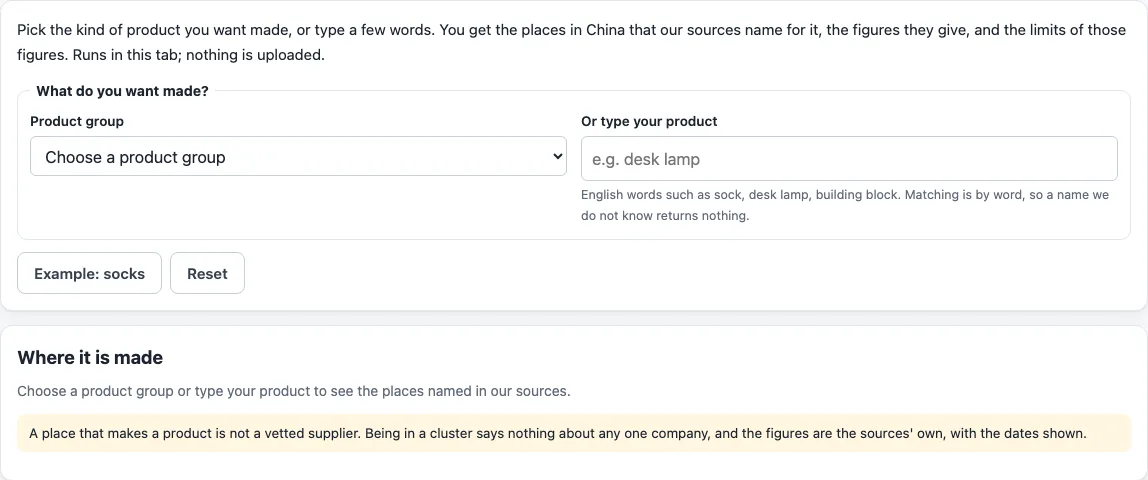
How to use the Manufacturing region finder
- Open the ‘Product group’ drop-down and choose the group closest to your product, for example ‘Socks’.
- Or click the ‘Or type your product’ box and type an English word. It matches the start of a word, so ‘sock’ finds socks and ‘desk lamp’ finds lamp and desk.
- Click ‘Example: socks’ to see a sample result before you try your own product.
- Read the result list. Places are ranked first by how many of the matched product groups name them.
- For each place, read what it makes, the figures, the source name and link, the date we read the source, and the ‘Limit’ line.
- If nothing matches, the tool tells you so and does not guess.
- Use the four next-step links: write one RFQ, verify the company, factory or trading company, and price the import.
- Click ‘Reset’ to clear your choice and start again.
Read the ‘Limit’ line before the numbers. It tells you whether a figure is market turnover, an organizer’s claim or a share from an older year, and that decides how much weight it can carry.
Use ‘Copy this shortlist’ to keep the results you want to compare later. Run the tool once for each product so that each shortlist stays separate.
Where are Chinese manufacturers located?
This page’s list is not a map of all Chinese manufacturing. It holds nine places, each included only because a page we read says what it makes: five in Guangdong province (Shenzhen, Dongguan, Foshan including Shunde, Guzhen in Zhongshan, and Chenghai in Shantou) and four in Zhejiang province (Yiwu, Keqiao in Shaoxing, Datang in Zhuji, and Cixi in Ningbo). Two examples of what the sources say: China Daily (2022) reports that Datang makes as many as 27 billion pairs of socks a year, and Xinhua (2021) reports that Chenghai has over 10,000 toy companies.
Is there a directory of Chinese manufacturers?
There is no complete official public directory of Chinese manufacturers that we found to point to. The National Enterprise Credit Information Publicity System (gsxt.gov.cn, in Chinese) is the state registry of business entities; People’s Daily reports it is free and had collected 182 million entities by the end of October 2023. Company-run platforms such as Alibaba.com and Made-in-China.com work as directories, but this site is not one and has no listings.
Which Chinese city makes my product?
The result ranks places by how many matched product groups name them, so a place named under two groups appears first. For socks, Datang in Zhuji comes first, then Yiwu. For an LED desk lamp, Foshan comes first because it is named under both lighting and furniture, then Guzhen and Dongguan. The tool covers only nine places and does not know every product, so a missing place does not mean no one makes your product.
Is a manufacturing cluster a guarantee of a good supplier?
No. A cluster is a concentration of makers, so it gives you more options and more competition, but it says nothing about any single company’s quality, price or reliability. Verify each supplier and ask whether it makes the product or trades it. A trading company is a normal business, but you should know which one you are dealing with.
How old are the figures?
The figures come from different years, from 2016 to 2026, and they measure different things: output, market transactions, exports, or share of a market. For example, the Dongguan zone page is dated 2018 with data as of December 2016, and the Keqiao figure is market turnover, not output. Several figures are promotional or organisers’ claims, so the numbers cannot be compared across places, and each result shows the source and the date we read it.
Sources read for this page
Opened on the dates shown; notes say where we used a substitute.
- Shenzhen Government Online / Szdaily.com: Shenzhen's expanding foreign trade diversification (updated 2026-01-15) (read 2026-10-17). A city-government news page.
- Dongguan Songshan Lake Hi-Tech Zone administrative committee: Industrial advantages (page dated 2018-10-15, data as of December 2016) (read 2026-10-17). An investment-promotion page of a Dongguan zone; the shares are from December 2016 and are promotional. Used only as a pointer to what Dongguan makes.
- China Daily (Foshan Hi-tech Zone advertorial section): Foshan Hi-tech Zone eyes smart home industry cluster (2021-11-25) (read 2026-10-17). Sits in a zone-sponsored section of China Daily (marked Advertorial); treat the figures as promotional.
- China Daily via english.www.gov.cn: International buyers flock to a lighting fair in Zhongshan (2024-03-19) (read 2026-10-17). The output and market-share figures are attributed to the fair organizers in the article.
- Xinhua via China Daily: Though afar, toys ride e-commerce from their 'capital' to overseas (2021-12-16) (read 2026-10-17). 2021 figures.
- People's Government of Shantou City, from Shantou Daily: Chenghai toy industry (2021-12-03) (read 2026-10-17). Read through a page summary, not the full text; used only for the chain stages (design, materials, moulds, parts, assembly).
- ezhejiang.gov.cn / China Daily: Shaoxing's Keqiao weaves new future (2025-02-05) (read 2026-10-17). Published by the Shaoxing municipal information office.
- China Daily (Shaoxing government section): East Chinese town of Datang socks it to world (2022-06-02) (read 2026-10-17). 2022 figures; the article says statistics, without naming who compiled them.
- China Daily: How a county seized global lead in home appliances (2023-10-16) (read 2026-10-17). The article's headline claim of 60 percent of appliances globally is not repeated on this site; the unit counts are.
- Xinhua via China Daily: China's Yiwu witnesses record-high foreign trade in 2025 (read 2026-10-17)
- Yiwugo.com news item of 2018-12-04: Futian Market districts, booths and categories (read 2026-10-17). Figures are from 2018 and have changed; confirm the current layout.
- People's Daily, 2023-12-13: National Enterprise Credit Information Publicity System (Chinese) (read 2026-10-17)
Frequently asked questions
Is this tool a China manufacturer directory?
No. It lists regions that published sources name for a product, not companies, and it ranks no company. Use the region to decide where to look, then find and check suppliers separately.
Does the tool send my product search to a website or server?
No. It runs in your browser, uploads nothing, and does not query any website.
What does the 2.78 yuan per pair figure for socks mean?
The tool computes it by dividing Datang’s 75 billion yuan by 27 billion pairs, which gives an average across all kinds of socks. At the source’s own dollar figure, it is about 0.41 US dollars per pair. It is not a price to expect for your order.
What if my product is not in the list?
The tool says so when nothing matches and does not guess. Try a broader product group or a related word, and use the related pages below to look for suppliers another way.
Why does the page name no companies?
A page that picked companies would have to vouch for them, and we have not audited anyone. The finder stops at the place, and the next steps are the checks you run yourself on each supplier.
Which places does the finder cover?
Nine: Shenzhen, Dongguan, Foshan (including Shunde), Guzhen in Zhongshan, Chenghai in Shantou, Yiwu, Keqiao in Shaoxing, Datang in Zhuji and Cixi in Ningbo. Each is there because a page we opened says what it makes, and each result links to that page.
Related tools
- How to find a manufacturer: Use this when you have chosen a region and need to write an RFQ and send it to several suppliers.
- Alibaba supplier verification: Use this to decode a licence code and check a Chinese company before you pay.
- Factory vs trading company: Use this when you need to find out whether a supplier makes the product or buys and resells it.
- How to import from China: Use this when you are ready to plan shipping, costs and paperwork after choosing a supplier.
- Yiwu market: Use this to see how the Yiwu market is laid out and what each district sells.
- China wholesale suppliers: Use this to see where wholesale suppliers are found and how to contact several of them with one request.