Buy From China Safely
Order of operations for a first purchase, with a checker for the supplier and the payment you were asked to make.
The Supplier legitimacy checker on this page helps you look at a Chinese supplier before you buy from China, by turning what you know about the company into a list of risk signals. It runs in your browser, is free, needs no sign-up, and uploads nothing.
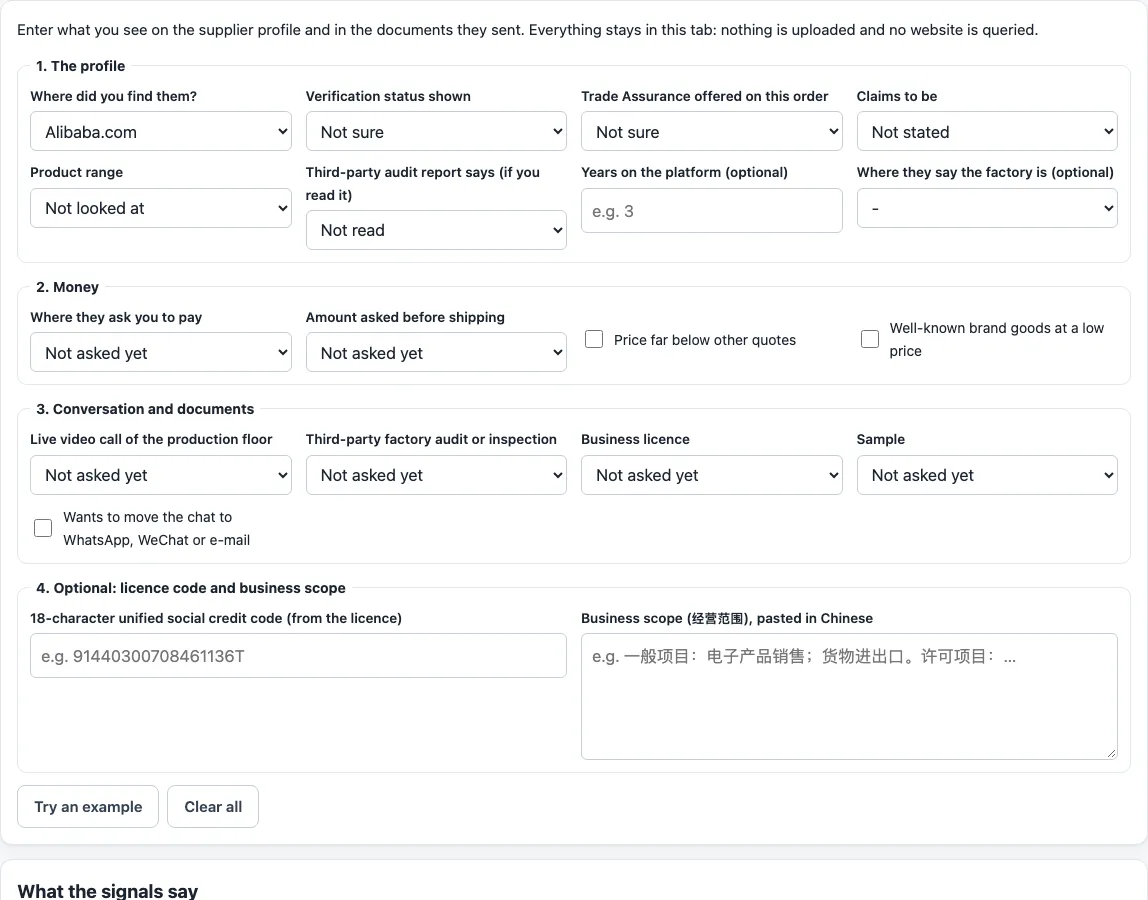
Alibaba’s own buyer guide says sellers range from real manufacturers to unverified traders and scammers, and a listing alone does not tell you which you are dealing with. The checker asks about the supplier: where you found it, what verification it shows, whether Trade Assurance is offered, what it claims to be, and how it wants to be paid. It then reports High, Medium, Reassuring and Note signals, each with a reason and source links, plus a list of next checks. The result is a set of signals based on your answers, not an audit or a verdict on any company.
How to use the Supplier legitimacy checker
- Answer where you found the supplier and what verification status is shown.
- Say whether Trade Assurance is offered.
- Record what the supplier claims to be and how wide its product range is.
- Say whether a third-party audit report exists and what it says.
- Enter where the supplier asks you to pay and how much it wants before shipping.
- Mark whether the supplier refused a live video of the production floor, a factory audit, the business licence or a sample.
- Mark whether the price is far below other quotes you have received.
- Optional: enter the 18-character unified social credit code. The tool checks it against its check character and decodes the registering department, entity type and region code of the registration authority.
- Optional: paste the business scope in Chinese. The tool highlights manufacturing words (生产, 制造, 加工) and trade words (批发, 销售, 进出口) with English meanings.
- Read the results: risk signals marked High, Medium, Reassuring or Note, a “Looks like a manufacturer / Looks like a trading company / Unclear” card with its evidence, and the next checks.
When you are finished, press the Print checklist button to print a one-page check sheet. Keep it with your order notes so you can compare it with later messages from the supplier.
Is it safe to buy from China?
Buying from China is not unsafe in itself. The risk depends on the specific supplier and on how you pay. A trading company is a normal kind of business, so the useful question is whether the seller is who it says it is and whether your payment is protected.
Alibaba’s 2026 buyer guide says that anyone can list products on the platform, so sellers range from real manufacturers to unverified traders and scammers. It also says verification does not guarantee product quality or ethical practices. The badges mean different things:
- Gold Supplier: the business is verified as legally registered by a third-party institution.
- Verified Supplier: a Gold Supplier whose profile, management, production and processes have been assessed or inspected by third parties. Alibaba says an assessment report is open to all buyers, but its page does not name the inspection company.
- Trade Assurance Supplier: a Gold Supplier that accepts payment through Alibaba.com, which enables payment and order protection.
Check which badge is shown, because each one answers a different question. Red flags listed by Alibaba include suppliers who refuse video calls or live factory footage, push you toward payment off the platform, or request full prepayment by wire transfer. Its safety blog also treats a usually expensive product listed for very little as a warning sign, and says well-known brands sold cheaply are likely knock-offs.
How do I pay a Chinese supplier safely?
Pay through the platform’s protected payment method, and do not send money outside it. Alibaba’s Help Center says payments made outside the platform cannot be protected. On Alibaba.com, Trade Assurance covers refunds for orders that are not shipped, go missing, or arrive with defects, incorrect items, damage or other product problems. Funds are held in escrow and released to the supplier after you receive and confirm the goods. The Trade Assurance page gives no coverage limits or refund caps, so read the terms before you rely on them.
The usual pattern is a first payment with the balance due at shipment. Use this order of operations:
- Verify the company.
- Order a sample.
- Send a written purchase order.
- Pay the deposit.
- Inspect the goods before paying the balance.
- Ship.
Sources read for this page
Opened on the dates shown; notes say where we used a substitute.
- Alibaba.com Help Center: payments outside the platform cannot be protected (read 2026-10-17)
- Alibaba.com: How sourcing on Alibaba.com works (badges, Trade Assurance, samples, payment) (read 2026-10-17)
- Alibaba.com: Trade Assurance (read 2026-10-17)
- Alibaba.com buyer guide: Is Alibaba B2B legit? (2026-02-28) (read 2026-10-17)
- Alibaba.com blog: How to safely buy and sell on Alibaba.com (2022-05-27) (read 2026-10-17)
- Alibaba.com: Verified Supplier (seller page) (read 2026-10-17)
- FBI IC3 PSA I-091019: Business Email Compromise, the $26 billion scam (2019-09-10) (read 2026-10-17)
Frequently asked questions
Should I order a sample first?
Yes. Alibaba recommends a sample before the full order, and its safety blog recommends one before bulk orders. Test the sample against your written specification, and note it if the supplier refuses to provide one.
What if the goods are wrong?
If you paid through Alibaba.com, open a claim for items that are wrong, defective, damaged or missing. Keep photos, your purchase order and all messages, and keep the conversation in the Message Center, as Alibaba recommends. Trade Assurance protection covers 30 days after you receive the order. If you paid outside the platform, that protection does not apply.
Does a Gold Supplier or Verified Supplier badge guarantee quality?
No. Alibaba says verification does not guarantee product quality or ethical practices. Treat a badge as one input and still check the sample and the production inspection.
Is a trading company a warning sign?
Not on its own. A trading company is a normal kind of business. The checker shows whether the supplier looks like a manufacturer, a trading company or unclear, with the evidence behind that card. What matters most is whether the company is who it says it is and how you pay.
What if I receive an email asking me to change payment details?
Confirm the change through a separate channel, such as a phone number you already have, and do not reply to the email. Check the sender address and links for misspelled domains. If you have already been defrauded, contact your bank immediately to request a recall, and file a complaint at ic3.gov, the FBI’s Internet Crime Complaint Center.
Related tools
- Alibaba scam patterns: Read this before you pay if a listing or message seems unusual.
- How to import from China: Use this for the steps after you choose a supplier, such as shipping and customs.
- Verify a supplier: Use this to check a supplier’s badges and registration before you contact them.
- RFQ builder in the manufacturer guide: Use this to write a clear request for quotes that suppliers can answer the same way.