China Sourcing: Guide and Tools
Check a supplier before you pay, price an import to your door and write an RFQ. Free tools that run in your browser, with the sources behind every rule.
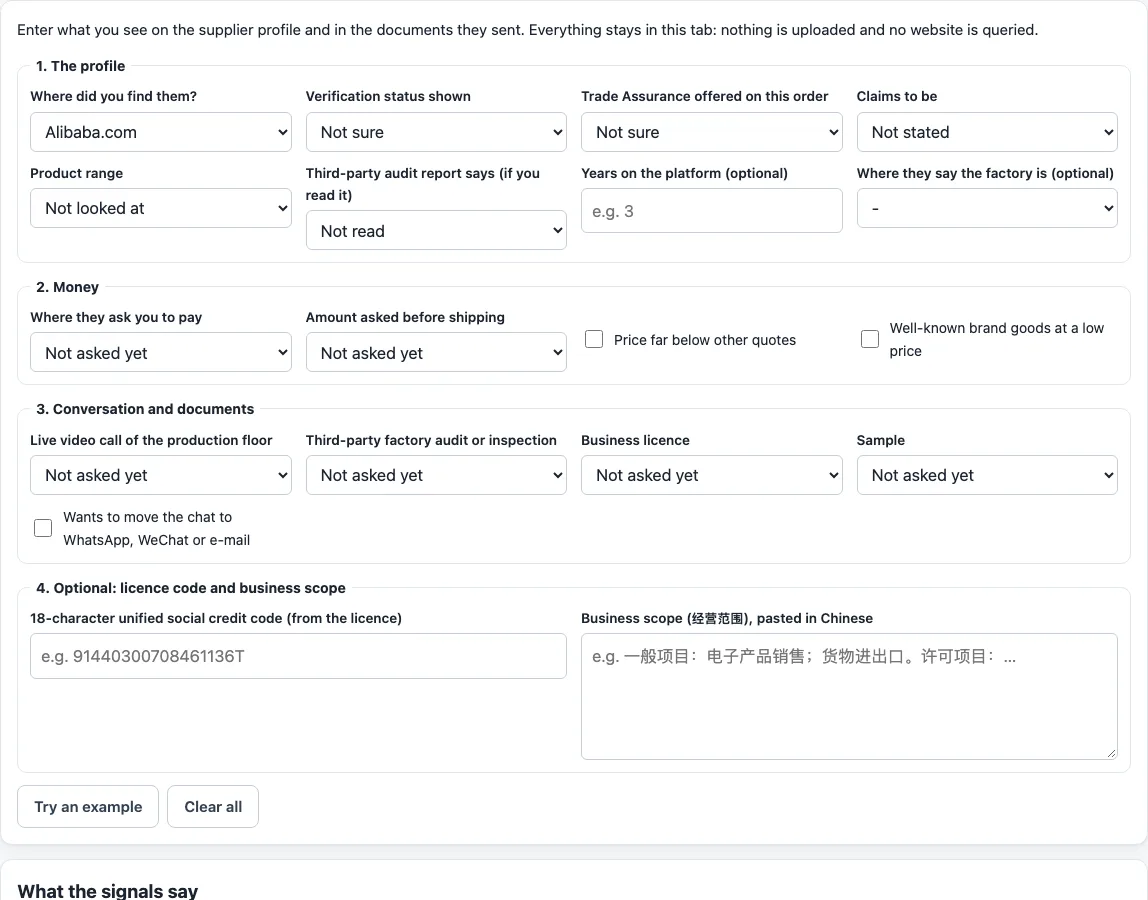
How to use the Supplier legitimacy checker
- Work through the questions on the checker at the top of this page. Start with where you found the supplier, the verification status shown, and whether Trade Assurance is offered.
- Enter what the supplier claims to be and how wide the product range is.
- Say what a third-party audit report shows, if the supplier has one.
- Enter where the supplier asks you to pay and how much they want before shipping.
- Say whether the supplier refused a live video of the production floor, a factory audit, the business licence or a sample.
- Say whether the price is far below other quotes you have received.
- Optional: enter the 18-character unified social credit code. The tool checks it against its check character and decodes the registering department, entity type and region code.
- Optional: paste the business scope in Chinese. The tool lists manufacturing words (生产, 制造, 加工) and trade words (批发, 销售, 进出口) with English meanings.
- Read the result. Each risk signal is marked High, Medium, Reassuring or Note, with a short reason and source links. The manufacturer or trading company card shows the evidence behind it, and the next checks list tells you what to verify.
When you are done, press Print checklist to print a one-page check sheet.
How do I start sourcing from China?
Start by writing down exactly what you want to buy, then find several suppliers who can make it. A clear written product definition is what lets you compare quotes fairly.
A first project usually follows these steps:
- Define the product in writing, including specifications, quantity tiers and any certifications you need.
- Find candidates on a platform, at a trade fair or through an agent.
- Send the same request for quotation to several suppliers, so the prices and terms can be compared.
- Check each company’s licence, hold a video call, and ask for an audit report if one exists.
- Order a sample and check its quality yourself.
- Agree payment terms in writing before you pay anything.
- Inspect the goods before you pay the balance.
- Ship, clear customs and work out the landed cost.
Each step has its own guide on this site, linked under Related tools below.
How do I check a Chinese supplier before paying?
Check the company’s registration, ask for a live video of the production floor, and request a sample before any large payment. A supplier who refuses these basic checks is a warning sign in its own right.
Also look at these points:
- Payment: Be cautious of any supplier who wants the full amount before shipping. Agreeing staged payments tied to inspection gives you more protection.
- Price: Alibaba’s own safety advice calls a usually expensive product listed for very little a sign that something is wrong. Compare several quotes for the same specification.
- Business type: A trading company is a normal kind of business, but you should know which one you are dealing with. A factory makes the goods, while a trading company buys them from others and resells them. Check that the business scope matches what you need.
- Platform badges: Alibaba.com and Made-in-China.com each publish what their badges mean on their own pages. Neither badge is a guarantee, so treat it as one data point among several.
Sources read for this page
Opened on the dates shown; notes say where we used a substitute.
- Alibaba.com: How sourcing on Alibaba.com works (badges, Trade Assurance, samples, payment) (read 2026-10-17)
- Alibaba.com buyer guide: Is Alibaba B2B legit? (2026-02-28) (read 2026-10-17)
- Made-in-China.com: Audited Supplier (read 2026-10-17)
- FBI IC3 PSA I-091019: Business Email Compromise, the $26 billion scam (2019-09-10) (read 2026-10-17)
- NDRC / State Council plan for the unified social credit code (structure of the 18 characters) (read 2026-10-15). Read by an earlier session for the yunfale site (Chinese).
- People's Daily, 2023-12-13: National Enterprise Credit Information Publicity System (Chinese) (read 2026-10-17)
Frequently asked questions
Is the Supplier legitimacy checker enough to confirm a supplier is real?
No. It gives you a list of signals based on the answers you enter. It is not an audit, so use it to decide what to check next, not as proof that a company is genuine.
Does the checker send my answers anywhere?
No. It runs in your browser, uploads nothing, and does not query any website. You do not need to sign up to use it.
Does the checker only work for suppliers on Alibaba?
No. You answer questions about the supplier wherever you found it. Platform names appear only to show which platform a rule applies to.
What does “Looks like a trading company” mean?
It means the evidence points to a company that buys and resells products rather than making them. A trading company is a normal kind of business, so the result helps you match the supplier to what you need.
What does it cost to import from China?
The total landed cost is the product price plus international freight, insurance, import duties and taxes, customs clearance fees and delivery from the port to your door. Duty rates depend on the product and the country you import into, so check the rate for your own situation. The Landed cost calculator on this site can help you add these costs up.
What should I do if a supplier refuses a factory video?
Treat the refusal as a warning sign and ask again in writing. If the supplier still refuses, consider a different supplier or a third-party inspection before you pay.
Related tools
- Is Alibaba legit? Read this when you are deciding whether to trust suppliers you found on Alibaba.
- How to import from China Read this when you want the full process from order to customs clearance.
- How to find a manufacturer Read this when you need a factory rather than a trading company.
- Chinese wholesale websites Read this when you are comparing the sites where wholesale suppliers list their products.